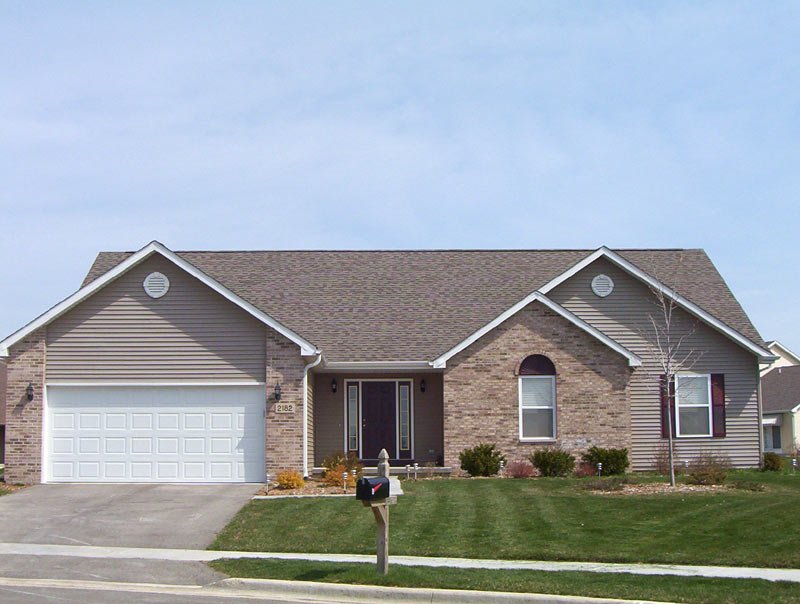
 Beehive Safety
Stop Arguing About Whether It Happened.
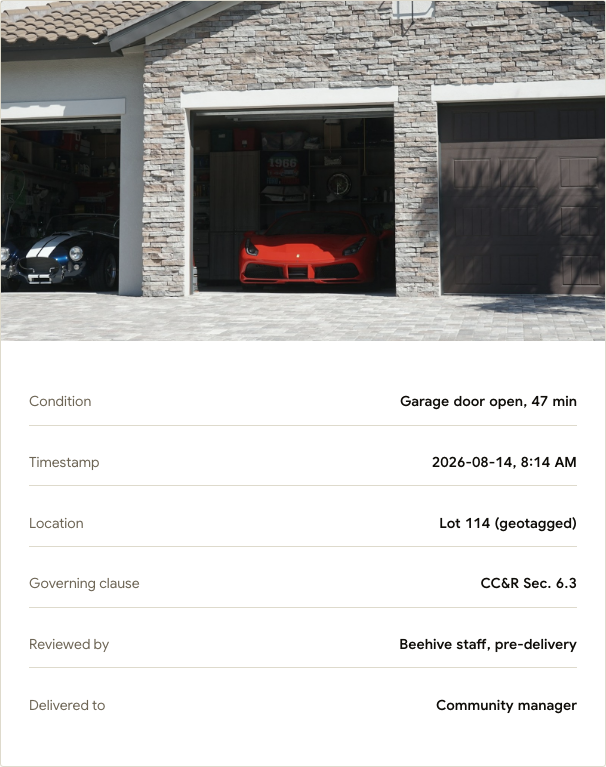
Beehive's drones fly scheduled surveys of your community, capturing timestamped, geotagged photos of what's visible from the street. A person checks every flag before it becomes documented, defensible evidence your board can act on.
How the Evidence Gets Built
From your governing documents to a packet your board can actually use.
Upload your CC&Rs
Upload your CC&Rs, ARC guidelines, and any addenda. Beehive reads the document and extracts the conditions it can reliably confirm from the street.
Survey
Drones fly a scheduled route within daylight hours, sized to your community, photographing street-facing property and common areas only.
Review every flag
Every flagged condition is checked by a person before it's included in an evidence packet.
No flag reaches your board unreviewed.
Deliver the packet
The packet, with photo, timestamp, geotag, and the specific governing-document clause it relates to, goes to your manager or board, who issue the actual notice.
We Don't Send Notices. We Send Proof.
Beehive doesn't draft or send violation notices. That stays with your manager or board, who know your community and your governing documents. What Beehive delivers is proof: dated, located, and matched to the exact clause it supports.
The conversation isn't "trust me." It's "here's the photo."
Upload Your Governing Documents. We'll Build the Survey Schedule.
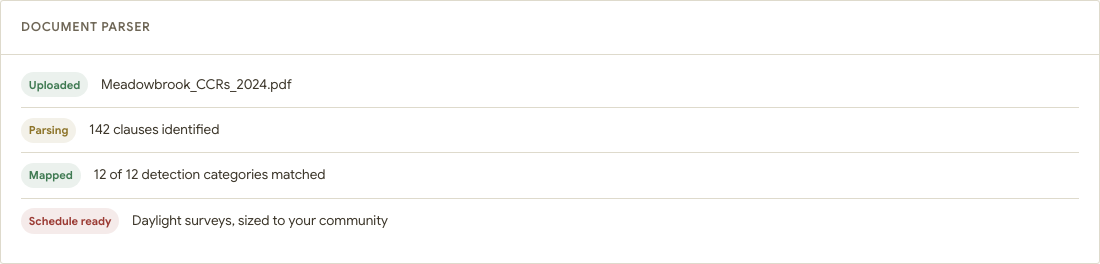
Drop in your CC&Rs and ARC guidelines. Beehive reads the document and maps every clause it can reliably verify from a street-facing aerial photo to a detection category, with no manual configuration required.
- Upload your CC&Rs, bylaws, or ARC guidelines as a PDF or Word doc
- Clauses are parsed and mapped to a detection category, or flagged as not reliably verifiable from the air
- A daylight survey schedule is generated and ready to review
Conditions We Can Reliably Verify From the Street
Beehive only documents conditions visible from the street or a common area that don't depend on identifying who a person is. A few categories from older HOA-tech playbooks (satellite dish placement, flag display, political signage, drought-tolerant landscaping, clotheslines, breed-based pet rules) are left off this list on purpose: they're federally or state-protected in many U.S. jurisdictions, and enforcing them automatically would be a disservice to your board, not a feature.
Trash & Bin Placement
Cans visible from the street outside the approved collection window.
Exterior Paint
Street-facing siding, shutters, and doors compared against the approved color book.
Holiday Decor Timing
Lights and displays installed early or left up past the posted removal date.
Street & Driveway Parking
Overnight street parking and driveway overflow visible from the road.
Commercial & Recreational Vehicles
Work trucks, RVs, boats, and trailers parked anywhere visible from the street.
Garage Door Duration
Doors left open beyond the association's permitted duration.Confirmed with a timely second look, not a single photo.
Visible Personal Property
Equipment or clutter left in view from the street or a common area.
Unapproved Structures
Sheds, swing sets, and similar additions visible from the street.Beehive flags the change; your manager confirms approval status.
Unapproved Exterior Work
Additions and hardscaping visible from the street.Beehive flags the change; your manager confirms approval status.
Wildlife Feeding
Bird feeders and pet food left out in violation of posted wildlife policy.
For-Sale & Rental Signage
Signage displayed outside its approved posting window.
Your Security Team, With Eyes They Didn't Have.
Beehive Safety doesn't replace the security or HOA staff you already have, it gives them a way to catch what they'd otherwise miss. When a vehicle on a street or driveway doesn't match your community's registered-vehicle list, an alert goes straight to your on-site security staff or a board-designated contact. They decide what happens next.
-
Beehive never contacts law enforcement, and never acts on an alert. An alert goes to your designated contact and nowhere else.
-
No Beehive review before an alert is sent. Your own staff is the first and only human in the loop.
-
Vehicle matching, not identity matching. No facial recognition, no biometric identification of any person, ever.
Coverage You Can Actually Plan Around
How much coverage you get is a function of how many drones you deploy against how much property there is to cover. A handful of drones for a large portfolio means periodic scheduled surveys; enough drones for a smaller property can mean coverage that's close to continuous, within daylight and twilight hours. The scheduler balances flight time against your property's size to compute what's actually achievable. Estimate it for your community or portfolio below. This is a planning estimate, not a coverage guarantee.
Built for How You Actually Work
Manage multiple communities?
Standardize documented compliance across your whole portfolio from one dashboard, with per-community CC&Rs handled individually.
For Management Companies →On an HOA board?
See what a single-community pilot looks like, what to bring to your board vote, and how to loop in your management company.
For HOA Boards →A Few Common Questions
A person checks the flag, and if it holds up, it's added to an evidence packet: photo, timestamp, geotag, and the matching governing-document clause, delivered to your manager or board. Beehive doesn't draft or send the notice itself.
It depends on how many drones you deploy relative to your property's size. A modest deployment runs scheduled surveys within daylight hours; a large enough fleet for the area covered can approach continuous coverage during those hours. We don't yet have validated data on full overnight operation, so that's not something we promise by default.
Street-facing property and common areas only. No audio, no thermal imaging, no backyard or pool imagery, and no facial recognition or identity matching. Full detail is on our Trust & Privacy page.
30 days by default. Footage tied to an open violation is kept up to 12 months, through resolution and any appeal window. We don't offer indefinite retention. See our full retention policy.
Yes. A vehicle that doesn't match your community's registered-vehicle list triggers a notification to your own security staff or a board-designated contact. Beehive doesn't review the alert first and never contacts law enforcement; your staff decides what happens next. See how alerting works.
More questions, including opt-out and legal details? See the full Trust & Privacy FAQ.
Request a Coverage Plan
Tell us about your community or portfolio and we'll follow up with a survey plan and pricing tailored to your home count.